
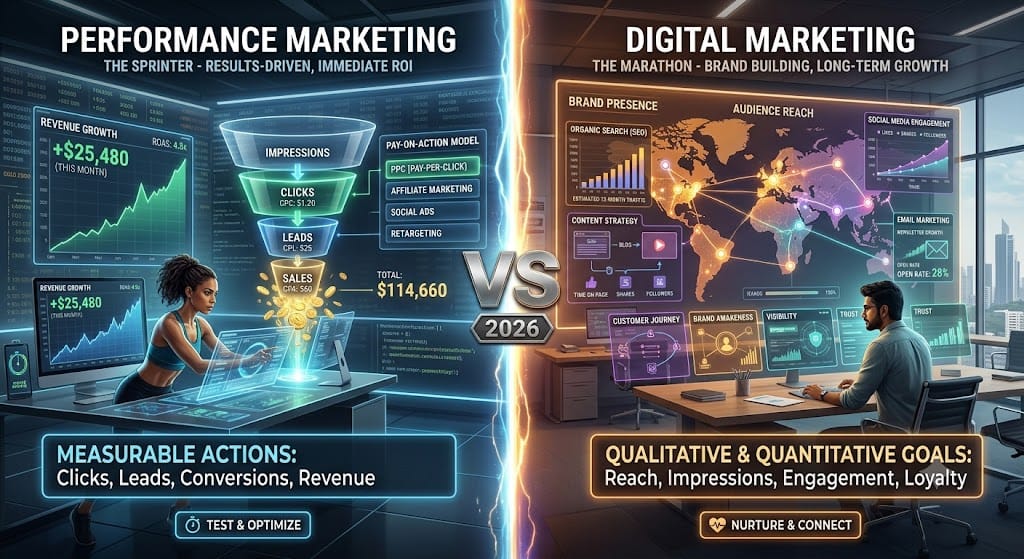
Businesses today have more marketing options than ever before. From search engine optimisation and social media campaigns to paid ads and influencer partnerships, brands are investing heavily in digital channels to attract customers and increase revenue.
However, one question continues to dominate boardroom discussions: Performance Marketing vs Digital Marketing — which approach delivers better return on investment (ROI)?
The answer is not always straightforward. Both strategies offer unique advantages, and the right choice often depends on your business goals, budget, and growth stage.
In this guide, we’ll compare Performance Marketing vs Digital Marketing to help businesses understand which strategy can generate better ROI in 2026 and beyond.
Understanding Digital Marketing
Digital marketing is a broad term that includes all online marketing activities used to promote a business, product, or service.
It focuses on building long-term brand awareness, customer relationships, and sustainable growth through multiple digital channels.
Common digital marketing activities include:
- Search Engine Optimisation (SEO)
- Content Marketing
- Email Marketing
- Social Media Marketing
- Website Optimisation
- Online Reputation Management
The primary objective of digital marketing is to create a strong online presence that continuously attracts and engages potential customers.
What Is Performance Marketing?
Performance marketing is a results-driven marketing approach where businesses pay only when a specific action occurs.
These actions may include:
- Clicks
- Leads
- Sales
- App installs
- Form submissions
Unlike traditional campaigns that focus primarily on visibility, performance marketing emphasises measurable outcomes and return on investment.
Popular performance marketing channels include:
- Google Ads
- Facebook Ads
- Instagram Ads
- LinkedIn Ads
- Affiliate Marketing
- Native Advertising
Because every campaign can be tracked in real time, businesses can quickly optimise budgets and improve campaign performance.
Key Differences Between Performance Marketing and Digital Marketing
While both approaches aim to grow businesses online, they differ significantly in execution and outcomes.
| Aspect | Digital Marketing | Performance Marketing |
| Primary Goal | Brand awareness and long-term growth | Measurable actions and conversions |
| Results Timeline | Medium to long term | Short to medium term |
| Budget Usage | Fixed or ongoing investment | Spend based on campaign performance |
| Success Metrics | Traffic, engagement, visibility | Leads, sales, ROI, conversions |
| Best For | Brand building and organic growth | Immediate lead generation and sales |
Understanding these differences is essential when evaluating Performance Marketing vs Digital Marketing for your business.
Which Strategy Delivers Faster Results?
When speed is the priority, performance marketing usually delivers faster outcomes.
Paid campaigns can start generating website traffic, enquiries, and sales within days of launch. Businesses can target audiences based on demographics, interests, behaviour, and location to achieve quick results.
Digital marketing strategies such as SEO and content marketing generally take longer to produce measurable outcomes. However, they continue to deliver value over time without requiring constant advertising spend.
For businesses launching a new product or entering a competitive market, performance marketing often provides an immediate boost.
Which Offers Better Long-Term ROI?
Long-term ROI often depends on business objectives.
Digital marketing strategies such as SEO, content marketing, and organic social media help businesses build lasting visibility and credibility. Although these strategies require patience, they can continue generating traffic and leads for years.
Performance marketing, on the other hand, can produce excellent short-term ROI but usually requires ongoing investment. Once advertising campaigns stop, traffic and lead generation may decline.
Businesses looking for sustainable growth often combine both approaches to maximise returns.
Performance Marketing vs Digital Marketing for Small Businesses
For startups and SMEs with limited budgets, choosing the right strategy is critical.
Many entrepreneurs searching for the best marketing agency for small business often ask whether they should prioritise organic growth or paid campaigns.
The answer depends on business goals.
Small businesses that need immediate enquiries or sales may benefit from performance marketing. However, investing solely in paid campaigns without building a strong digital presence can limit long-term growth.
A balanced approach that includes SEO, content creation, and paid advertising often delivers the best results.
The Growing Role of Social Media in ROI
Social media platforms continue to influence purchasing decisions across industries.
Businesses increasingly invest in Social Media Management Services to strengthen brand visibility, engage audiences, and support both organic and paid campaigns.
Effective social media strategies can:
- Build customer trust
- Increase website traffic
- Improve customer retention
- Support lead generation efforts
- Enhance paid campaign performance
Social media has become a crucial bridge between digital marketing and performance marketing strategies.
How AI Is Changing Marketing ROI
Artificial intelligence is transforming how businesses measure and improve marketing performance.
Modern marketing campaigns now use AI to:
- Predict customer behaviour
- Optimize advertising budgets
- Personalize content
- Improve audience targeting
- Automate campaign reporting
As AI-powered search platforms continue to evolve, businesses need strategies that combine measurable performance with long-term brand building.
This shift is making the debate around Performance Marketing vs Digital Marketing even more relevant for businesses planning future growth.
Should Businesses Choose One or Combine Both?
Rather than choosing one strategy over the other, many successful businesses integrate both approaches.
A combined strategy allows businesses to:
- Generate immediate leads through paid advertising
- Build long-term organic visibility through SEO
- Strengthen brand authority with content marketing
- Improve customer engagement through social media
- Maximise overall marketing ROI
Using both strategies together creates a strong and sustainable growth engine.
Conclusion
The debate around Performance Marketing vs Digital Marketing does not have a one-size-fits-all answer.
Performance marketing is ideal for businesses seeking quick results, measurable conversions, and immediate ROI. Digital marketing, on the other hand, focuses on building long-term brand value and sustainable growth.
For most businesses, the best approach is to combine both strategies. By balancing short-term performance goals with long-term brand-building efforts, businesses can maximise ROI and create a stronger online presence in an increasingly competitive digital landscape.